

Timing Belt Replacement Guide: When Your Engine Needs It
- Cite Auto

- 6 days ago
- 9 min read
By: Cite Auto

Your engine may contain hundreds of moving parts, but some relatively simple components have an enormous responsibility. The timing belt is one of them.
Hidden behind protective covers and rarely visible during everyday maintenance, the timing belt helps keep critical engine components synchronized. When it is working correctly, you probably never think about it. When it becomes worn or fails, however, the consequences can be much more serious.
That is why timing belt replacement is an important part of preventive vehicle maintenance.
Unlike worn brake pads or a weak battery, a timing belt does not always provide obvious warning signs before it reaches the end of its service life. In some cases, the engine can seem perfectly normal right up until the belt develops a serious problem. Depending on the engine design, a broken timing belt can potentially cause extensive internal engine damage.
The challenge for drivers is knowing when replacement is actually necessary.
Should you replace the belt according to mileage? Does age matter? What if you purchased a used vehicle and have no maintenance records? Should the water pump be replaced at the same time? And what symptoms could suggest that the timing system needs professional attention?
This timing belt replacement guide explains what the belt does, when it may need replacement, which warning signs deserve attention, and why preventive service can be considerably easier than dealing with a timing belt failure.
1. Understanding What Your Timing Belt Does
Before discussing replacement intervals, it helps to understand why this belt matters so much.
Your engine relies on extremely precise timing. Pistons move up and down inside the cylinders while valves open and close to control the flow of air, fuel, and exhaust gases. These movements need to remain synchronized.
The timing belt helps make that happen.
What Is a Timing Belt?
A timing belt is a reinforced toothed belt used on many internal-combustion engines. It connects and synchronizes important rotating components, typically including the crankshaft and camshaft.
The crankshaft is connected to the movement of the pistons, while the camshaft controls the opening and closing of the engine's valves.
The teeth on the belt help maintain precise synchronization between these components.
If that timing changes significantly, the engine may not operate correctly.
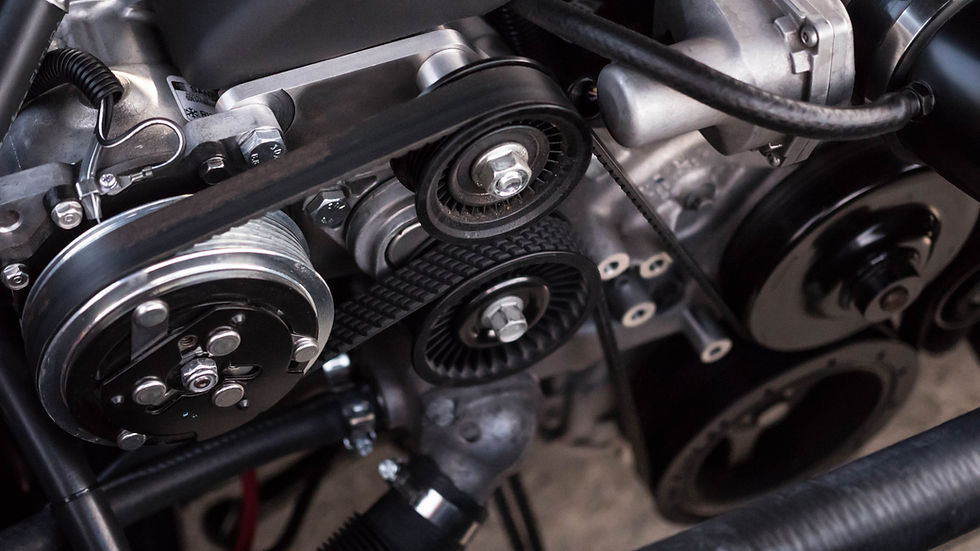
It is also important not to confuse a timing belt with an accessory or serpentine belt.
The accessory belt is generally visible from the outside of the engine and may operate components such as the:
alternator;
air-conditioning compressor;
power-steering pump on certain vehicles;
water pump on some engine designs.
The timing belt, by contrast, is usually located behind protective covers.
That means it cannot necessarily be inspected simply by opening the hood and looking at the engine.
Why Timing Belt Replacement Matters
Timing belts are manufactured to be durable, but they are still wear items.
Over time, the belt is exposed to repeated movement, engine heat, tension, and normal material aging.
Eventually, the belt can deteriorate.
This is where timing belt replacement becomes important.
If a timing belt becomes severely worn, stretches beyond specification, loses teeth, or breaks, synchronization between the crankshaft and camshaft can be disrupted.
The consequences depend heavily on the engine design.
Some engines are known as interference engines. In these engines, the pistons and valves occupy some of the same physical space inside the cylinder—but at different moments during normal operation.
Proper timing keeps them from making contact.
If the timing belt breaks and synchronization is lost, pistons and valves may collide. This can potentially result in damaged valves, pistons, cylinder-head components, or other internal engine parts.
In other words, replacing a timing belt as preventive maintenance can be much less complicated than repairing an engine after belt failure.
Timing Belt or Timing Chain: Know What Your Vehicle Has
Not every vehicle uses a timing belt.
Many modern engines use timing chains instead.
A timing chain performs essentially the same synchronization function but uses a metal chain rather than a reinforced rubber-style belt.
Timing chains and timing belts have different maintenance requirements.
A timing belt usually has a defined replacement interval specified by the vehicle manufacturer. Timing chains are generally designed for longer service, although they can still experience wear or problems involving guides, tensioners, lubrication, and other components.
This distinction matters when planning maintenance.
Before worrying about timing belt replacement, determine whether your engine actually has one.
Your owner's manual, maintenance schedule, vehicle manufacturer information, or a qualified mechanic can help confirm the timing system used in your specific engine.
Do not rely exclusively on the vehicle's make and model. Different engine options within the same model family can sometimes use different systems.
2. When Should You Schedule Timing Belt Replacement?
This is the question most drivers want answered: how long does a timing belt last?
Unfortunately, there is no universal mileage that applies to every vehicle.
The correct interval depends on the engine, manufacturer, model year, operating conditions, and sometimes both vehicle age and mileage.
Follow the Manufacturer's Timing Belt Replacement Interval
The best starting point is the manufacturer's maintenance schedule.
Depending on the vehicle, timing belt replacement may be recommended according to mileage, time, or a combination of both.
Some vehicles may have recommended intervals around 100,000 kilometres, while others can go considerably longer. The correct interval for your particular engine should always take priority over a generic recommendation.
Why does the manufacturer specify an interval rather than simply telling drivers to wait for symptoms?
Because timing belts can deteriorate without producing clear warning signs.
A vehicle can start normally, idle smoothly, and drive perfectly while the belt is approaching the end of its recommended service period.
Preventive replacement therefore reduces the risk of relying on a component beyond its intended service life.
If you are unsure when your belt is due, gather:
the vehicle year;
make;
model;
engine;
current mileage;
available maintenance records.
With this information, a mechanic can determine the appropriate service recommendation more accurately.
Age Matters Even When You Do Not Drive Much
Mileage receives most of the attention in vehicle maintenance, but rubber-based components also age with time.
Imagine two identical vehicles.
One travels 25,000 kilometres every year. The other travels only 6,000 kilometres annually.
The second vehicle will obviously take much longer to accumulate mileage, but its timing belt still experiences years of temperature changes and material aging.
This is why certain manufacturers specify both mileage and time-based replacement guidelines.
A low-mileage vehicle is not automatically exempt from timing belt maintenance.
Age can be particularly relevant for vehicles that:
are driven infrequently;
spend long periods parked;
have been stored for extended periods;
are older but have unusually low mileage;
have incomplete service histories.
If you own an older low-mileage vehicle, do not assume the timing belt is still healthy simply because the odometer has not reached a high number.
The recommended maintenance schedule remains the best reference.
Buying a Used Car With No Timing Belt Replacement Records
This is one of the most important situations to consider.
Suppose you purchase a used vehicle with 140,000 kilometres.
The previous owner says the vehicle was well maintained, but there are no invoices showing whether the timing belt was replaced.
What should you do?
First, determine whether the engine uses a timing belt and when the manufacturer recommends replacing it.
Next, check whatever service records are available.
Look for:
repair invoices;
maintenance receipts;
dealership service history;
stickers or markings indicating previous timing service.
If there is no reliable evidence that the work was performed and the vehicle is at or beyond the recommended interval, discussing preventive replacement with a mechanic is sensible.
Guessing is not a particularly good maintenance strategy when the component in question plays such an important role.
Establishing a known maintenance baseline can also make future ownership easier.
Once the service is completed and documented, you know exactly when the timing system was last addressed.
3. Warning Signs That Your Timing System May Need Attention
Scheduled maintenance is the preferred way to handle a timing belt, but drivers should still know which symptoms could indicate a timing-related problem.
These symptoms do not automatically mean the belt itself is failing. Several engine problems can produce similar behaviour.
The correct response is diagnosis rather than guessing.
Timing Belt Replacement and Unusual Engine Noises
A healthy engine should have a relatively consistent sound.
If you suddenly notice ticking, rattling, slapping, or other unusual noises coming from the timing area, have the vehicle inspected.
The sound could potentially involve:
a tensioner;
an idler pulley;
a bearing;
another component in the timing system.
Timing belt systems rely on more than the belt itself.
Tensioners help maintain the correct belt tension, while pulleys guide its movement. If one of these components develops a problem, the entire timing system can be affected.
Do not wait for an unusual mechanical noise to become dramatically louder before seeking diagnosis.
The sooner the cause is identified, the easier it is to determine the appropriate repair.
Rough Running, Misfires, or Difficulty Starting
A timing problem can potentially affect engine operation.
If synchronization is no longer correct, symptoms may include:
rough idle;
reduced performance;
hesitation;
misfires;
difficulty starting;
a check-engine light.
However, these symptoms can also be caused by many other issues.
Worn spark plugs, ignition coils, fuel-delivery problems, sensors, vacuum leaks, and other faults can create similar behaviour.
This is why simply searching the symptom online and deciding that your vehicle needs a new timing belt is not a reliable diagnostic method.
A professional technician can evaluate the symptoms, scan the vehicle for diagnostic trouble codes, and perform appropriate mechanical checks.
If the problem is related to the timing system, it can then be addressed based on evidence rather than assumptions.
Visible Oil or Coolant Leaks Near the Timing Area
Leaks around the engine should always be taken seriously enough to investigate.
Depending on the engine design, oil or coolant can potentially contaminate areas around the timing system.
A timing belt is designed to operate under specific conditions. Exposure to fluids may contribute to deterioration.
If you notice:
oil underneath the engine;
coolant loss;
residue around the timing cover;
fluid smells;
repeated drops in fluid levels,
have the source identified.
Do not assume every leak near the front or side of the engine is related to the timing belt. The engine contains numerous seals, gaskets, hoses, and components capable of leaking.
The important thing is to correct the actual source before it contributes to additional problems.

4. What Happens During a Timing Belt Replacement?
Timing belt service is more involved than replacing an accessory belt.
The belt is usually located behind protective covers and may require the removal or repositioning of several components before technicians can access it.
Precise installation is essential because the crankshaft and camshaft must remain correctly synchronized.
What Is Included in a Professional Timing Belt Replacement?
The exact procedure varies significantly between engines.
Generally, technicians need to gain access to the timing system, position the engine correctly, remove the old components, and install the new belt according to manufacturer specifications.
Critical steps can include:
accessing the timing belt assembly;
aligning timing marks;
maintaining correct crankshaft and camshaft positions;
replacing the belt;
setting proper tension;
inspecting associated components;
reassembling removed parts;
verifying proper engine operation.
This is precision work.
Being off by even a small amount in engine timing can cause poor operation and, depending on the engine, potentially more serious problems.
This is why timing belt service should follow the correct procedure for the specific engine rather than a generic one-size-fits-all approach.
Should You Replace the Water Pump at the Same Time?
You may hear mechanics recommend replacing the water pump during timing belt replacement.
Why?
On some engines, the water pump is located within or near the timing-belt area and may even be driven by the timing belt.
Accessing it can therefore require much of the same labour needed to reach the timing belt.
If the existing water pump has significant mileage, replacing it while the area is already accessible can sometimes make practical sense.
Other associated components may also be considered, including:
tensioners;
idler pulleys;
seals where appropriate;
related hardware.
However, the exact parts that should be replaced depend on the vehicle, manufacturer recommendations, component condition, and the design of the engine.
The best approach is to ask what is included in the service and why.
A mechanic should be able to explain which components are being replaced and whether they are part of a recommended timing-belt service kit.
Preventive Timing Belt Replacement vs. Engine Repair
One of the strongest arguments for preventive timing belt maintenance is the difference between planned service and unexpected failure.
A planned replacement allows you to:
schedule the appointment;
budget for the repair;
replace associated wear components when appropriate;
document the maintenance;
reduce uncertainty about belt age.
A sudden failure gives you none of those advantages.
The vehicle may stop running and require towing. If the engine is an interference design and internal contact occurs, the resulting repairs can be significantly more extensive than the original maintenance service.
That does not mean every overdue timing belt will fail tomorrow.
It means the risk becomes unnecessary when the manufacturer has already provided a recommended maintenance interval.
Preventive maintenance is often less exciting than repairing something after it breaks—and that is exactly the point.
The best timing belt problem is the one you never have.
Conclusion: Don't Wait for Your Timing Belt to Make the Decision for You
A timing belt may be hidden from view, but its job is essential. By keeping the crankshaft and camshaft synchronized, it allows critical engine components to operate in the correct sequence.
Because deterioration does not always produce obvious symptoms, timing belt replacement is one maintenance item where following the manufacturer's recommended interval matters.
Check your vehicle's maintenance schedule, consider both mileage and age, and pay particular attention if you purchased a used vehicle without reliable service records.
If your timing belt is approaching its recommended replacement interval—or you simply do not know when it was last changed—Centre de mécanique Cité Auto can help determine what your vehicle requires. As a local Montréal mechanic shop, the team can inspect your vehicle, review its maintenance needs, and help you plan the appropriate service before a worn timing component becomes a much bigger problem.
A little preventive maintenance today can make your next drive considerably less eventful—and when it comes to engine repairs, uneventful is usually exactly what you want.


Comments